
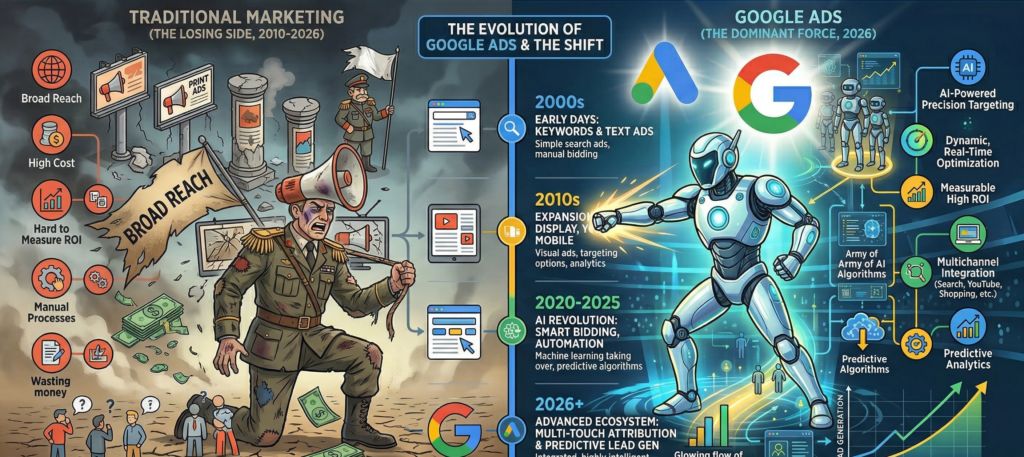
The marketing world has shifted. In 2026, the gap between businesses that thrive and those that barely survive comes down to one thing. While traditional ads are shouting at everyone in hopes that someone listens, savvy businesses are using Google Ads to whisper the exact answer to the person who just asked the question. If you are a business owner looking for ROI or a student starting your PPC journey, this is the most important shift you need to understand.
What You’ll Learn Today:
The “Guesswork” Era: Why old-school ads are failing your budget.
The Precision Era: How Google Ads turns marketing into a measurable science.
The Traditional vs. Digital Battle: A side-by-side comparison of where your money goes.
The Secret Sauce: How the Google Auction works (and why it’s not just about the highest bidder).
The 2026 Opportunity: Why this skill is recession-proof for students and vital for growth.
The Guesswork Era: Why Billboards and TV Ads are Failing You
The “Spray and Pray” Problem: High Costs with Zero Tracking
In the past, marketing was a giant gamble. You paid thousands of dollars for a billboard or a TV slot, “sprayed” your message across the city, and “prayed” that the right person saw it. In 2026, this is a recipe for a drained bank account. You cannot track how many people looked at a billboard and then walked into your store. You are paying for views from people who will never need your service.
Static vs. Dynamic: Why You Can’t “Edit” a Printed Ad
Imagine finding a typo in your phone number on a newspaper ad that just went to print for 50,000 people. You’re stuck. Traditional marketing is static—once it’s out, it’s permanent. In a fast-paced digital world, being unable to pivot or fix an error in real-time is a massive liability.
The Precision Era: Results You Can See, Measure, and Scale
What is Google Ads? More Than Just a Search Engine
Google Ads is no longer just a list of blue links. In 2026, it is a sophisticated AI-driven ecosystem. It uses billions of signals—like browsing behavior and real-time context—to place your business in front of users exactly when they are ready to buy. It’s not just an ad; it’s a solution provided at the perfect moment.
The ROI Advantage: Only Paying When Interest is Shown (PPC)
The “Pay-Per-Click” (PPC) model changed everything. Unlike a TV ad where you pay for the “possibility” of being seen, with Google Ads, you only pay when someone actually clicks your ad. This means every dollar spent is tied to a person who showed genuine interest in what you offer.
Real-time Data: Turning Marketing into a Science
With digital marketing, the “guesswork” is dead. You can see exactly which keywords brought in sales, which headlines performed best, and exactly how much it cost to acquire a single customer. This data allows you to scale your business with total confidence.
The Comparison: Traditional Marketing vs. Google Ads
The bridge between struggling for leads and having a predictable sales machine is choosing the right platform. Here is how they stack up in 2026:
| Feature | Traditional Marketing (TV/Print) | Google Ads (Digital) |
| Targeting | Broad / Demographic-based | Hyper-Targeted / Intent-based |
| Cost | Large upfront investment | Flexible (Pay-per-click) |
| Tracking | Estimations & Guesswork | Precise Conversion Tracking |
| Speed | Takes weeks to launch | Live in minutes |
| Engagement | Interrupts the audience | Answers the audience |
How It Works: The Google Auction Simplified
It’s Not Just About Money: Understanding the Quality Score
Many people think the biggest wallet always wins on Google. That’s a myth. Google uses a “Quality Score” to ensure users stay happy. If your ad is highly relevant and your website provides a great experience, Google will often rank you higher than a competitor who is bidding more money but has a low-quality ad.
Why Relevance is the Secret Sauce to Lower Costs
In 2026, Google’s AI is smarter than ever. It rewards “relevance.” When your ad perfectly matches what the user typed into the search bar, your “Cost-Per-Click” goes down. This allows small businesses to outsmart (not just outspend) the giants.
Why You (And Your Business) Need It in 2026
For Business: Capturing “High-Intent” Customers
Traditional marketing interrupts people while they are trying to enjoy a show or drive to work. Google Ads helps people. When someone searches for “emergency roof repair” at 2 AM, they have high intent. Being the answer to that search is the fastest way to grow your revenue.
For Students: The Most Recession-Proof Title in 2026
As long as businesses need customers, they will need Google Ads experts. Being a “PPC Specialist” is one of the most in-demand roles in the digital economy. It is a technical, data-driven skill that AI enhances rather than replaces, making it a secure and high-paying career path.
Preview of Blog 2: Where Should Your Ads Appear?
Now that you understand why Google Ads beats traditional marketing, the next question is: Where do we put the ads?
Google gives you two massive playgrounds: the Search Network (GSN) and the Display Network (GDN). One captures people who are actively looking, while the other builds your brand while people browse the web. Which one is right for your goals?
Find out in our next lesson…
Ready to Master the Lead Gen Game?
Don’t let your marketing budget disappear into the “guesswork” of the past. Start building a data-driven future today.
Subscribe now to get Part 2: “GSN vs. GDN” delivered straight to your inbox! Plus, you’ll receive our exclusive “Google Ads Vocabulary” cheat sheet to help you speak like a pro instantly.